 EUR
EUR USD
USD
Peptide calculators – supply, dosage & reconstitution ⚖️
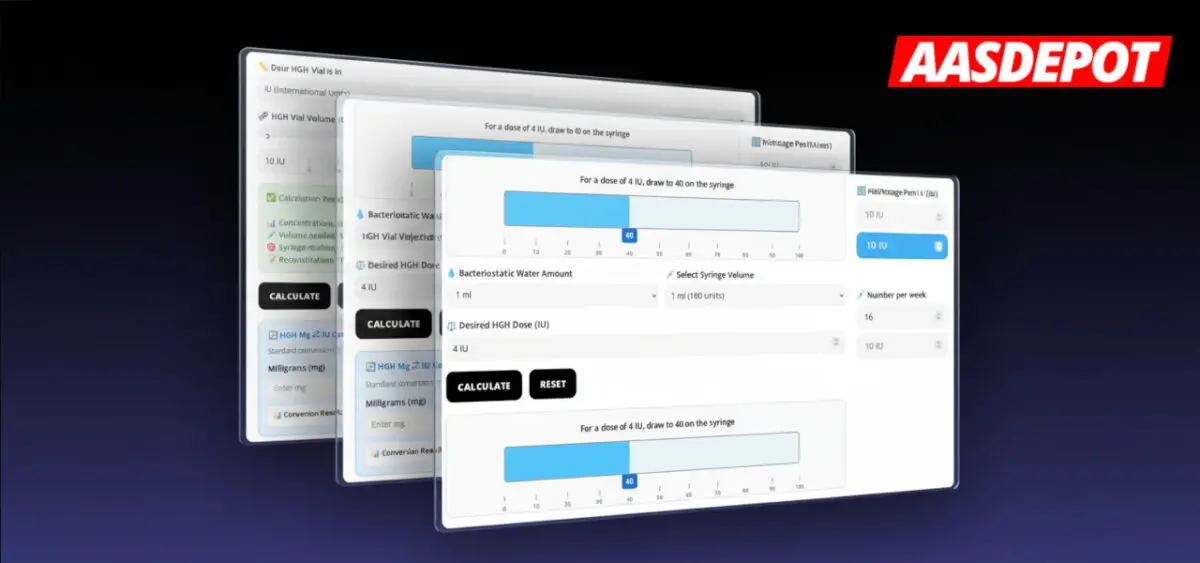
Here you have all necessary peptide calculators to determine exactly how many vials to order for your specific cycle — and to convert vial mg and water volume into accurate syringe draw amounts. Shopping is optional – purchases are subject to local law.
Peptide calculator #1 – supply
This tool estimates exactly how much peptide you’ll need for a cycle and how many vials to order. Select dose unit, dose per injection, injections per week, and cycle length — the peptide calculator #1 returns total peptide required and recommended vial counts.
Peptide calculator #1 – reconstitution & syringe guide
This peptide calculator computes reconstitution volumes and syringe draw amounts. Enter vial size and bacteriostatic water amount, then set your desired mcg dose — results show concentration, mcg per syringe unit, and exact draw per injection.
Peptides 🧬
Peptides are short chains of amino acids that act as precise signaling molecules. They influence sleep and circadian rhythm, growth-hormone release, metabolism, tissue repair, appetite, and inflammation. Because peptides are target-specific and smaller than full proteins, they’re widely used in research and clinical settings where precise modulation is needed.
How Peptide calculators work
Quick conversion & concentration
- Convert mass to mcg: 1 mg = 1000 mcg.
- Concentration (mcg/mL) = total peptide (mcg) ÷ total solvent (mL). Example: 1 mg (1000 mcg) in 2 mL → 500 mcg/mL.
Volume to draw
- Volume (mL) = desired dose (mcg) ÷ concentration (mcg/mL). Example: 250 mcg ÷ 500 mcg/mL = 0.5 mL (50 units on a 100‑unit syringe). 💉
Bacteriostatic water, sterile water, or normal saline (NaCl)
- Sterile water for injection (WFI): pure water, no salts or preservatives; hypotonic. Intended for immediate, single‑use reconstitution.
- Bacteriostatic water: sterile water + preservative (usually 0.9% benzyl alcohol); allows multiple withdrawals and refrigerated storage (commonly 14–28 days per manufacturer). Not suitable for some populations or routes (e.g., neonates, pregnant women, intrathecal).
- Normal saline (0.9% NaCl): isotonic sodium chloride solution; used for IV infusions, flushing, and some reconstitutions where isotonicity is required. Not the same as sterile water—contains salt. Which to use: follow the peptide manufacturer’s instructions; use bacteriostatic water for multi‑dose regimens when appropriate, sterile water or saline when single‑use or indicated.
Practical reconstitution notes
- Work on a clean surface; wash hands and disinfect vial septa with 70% isopropyl alcohol.
- Add solvent slowly down the vial wall (don’t blast powder); swirl gently—do not shake vigorously. Inspect for cloudiness/particulates; discard if present.
- Convert mg → mcg (1 mg = 1000 mcg), calculate mcg/mL, then compute mL to draw using formulas above.
- For syringe units: 1 mL = 100 units (so 0.5 mL = 50 units).
- When mixing peptides in one syringe, recalculate concentrations and confirm compatibility—mixing without recalculation increases dosing error risk. ⚠️
- If required draws are below syringe resolution, increase solvent volume (lower concentration) to make measuring easier, and recalc vial usage.
Dosing examples + common scenarios
- 5 mg in 2 mL → 5,000 mcg ÷ 2 = 2,500 mcg/mL. A 250 mcg dose = 0.1 mL (10 units).
- 10 mg in 5 mL → 10,000 mcg ÷ 5 = 2,000 mcg/mL. A 500 mcg dose = 0.25 mL (25 units).
- To simplify very small doses, increase solvent volume and recalc concentration and total vials needed.
Storage & handling
Short and long-term Storage
- Lyophilized (dry) peptides — short term: store at 2–8°C (refrigerator) for days to a few months if manufacturer permits.
- Lyophilized — long term: store at −20°C (freezer). For archival or highly sensitive peptides, −80°C is ideal.
- Reconstituted solutions (bacteriostatic water): refrigerate at 2–8°C, use within 14–28 days per supplier guidance.
- Reconstituted (sterile water, no preservative): plan for single-use or immediate short-term use; refrigerate and discard within 24–72 hours unless manufacturer states otherwise.
Best practices
- Avoid freeze–thaw cycles — aliquot reconstituted or diluted solutions into single-use vials/syringes.
- Use a dedicated refrigerator/freezer (avoid frost-free freezers due to cyclic warming).
- Protect from light and moisture; store vials in opaque boxes or wrap in foil; use desiccants for humidity control.
- Thaw sealed frozen vials at room temperature before opening (to avoid condensation). Thaw aliquots rapidly and use immediately.
- Use aseptic technique: sterile needles/syringes, disinfect septa, avoid touching needle tips. Discard any vial with discoloration, cloudiness, or particulates.
Containers, Labeling, and Transport
- Use clean glass or recommended high‑quality polypropylene vials (some plastics adsorb peptides).
- Label vials clearly with peptide name, concentration, total volume, reconstitution date/time, and expiry. Keep an inventory/log with lot numbers and storage temps.
- For transport, use insulated containers with cold packs (4°C) or dry ice (−20/−80°C shipments), minimizing transit time.
Troubleshooting & tips
If the peptide dissolves slowly, warm the vial gently by rolling it between your hands or place the sealed vial in warm water (not hot); never heat the vial directly or shake it violently. If particulates or clumps remain after gentle mixing, contact the supplier and do not use the product. Increase the reconstitution volume to make measuring small doses easier, and remember to recalculate the concentration and vial count accordingly. Keep a dosing log that records the date, time, vial used, concentration, and units drawn for full traceability.
Product availability and legal status vary by region. Buyers are responsible for ensuring compliance with local laws and regulations.
Why choose AASDEPOT?🔥
1000+ satisfied customers ✅
Best deals on the market
Lab-tested products from top manufacturers
24/7 customer support
Fast worldwide delivery 🌍
Top‑reviewed by customers (2025-2026) 🏆
🗨️ Telegram group: Grab great deals and connect now!